

A decision-making self-assessment shows you how you usually choose. It also shows where you get stuck. The best ones are short, honest and tied to a real decision in your life. A style quiz tells you your habit. It does not tell you which life area the habit is costing you most. That is why we pair it with a look at your whole life.
We built Life Audit Unfiltered for that second part. You rate ten life areas, answer written questions and get feedback. The Snapshot is free and needs no account. Below, you will find the main decision styles, questions to ask yourself and a way to read your results.
TL;DR
- Decision-making style is a learned habit, not a fixed trait. Researchers describe five common styles: rational, avoidant, dependent, intuitive and spontaneous.
- No style is best. Skilled decision makers switch styles depending on the situation.
- Guided self-reflection has helped people in studies, especially those who started out weaker at it.
- A style quiz is stronger when you also know which life areas feel off. Those areas are where your biggest decisions sit.
- You can start with our free Snapshot. It is anonymous and needs no account.
Table of Contents
- What a decision-making self-assessment is
- What a decision-making assessment test measures
- Questions to ask yourself before a big decision
- Does self-assessment actually help?
- Why your life areas matter to your decisions
- A simple routine to put your results to work
- Common mistakes
- Our view
- Start with the free Snapshot
- Related reading
- FAQ
- Sources
What a decision-making self-assessment is
It is a set of questions about how you approach choices. You answer them yourself. Then you read the pattern.
The British Psychological Society describes decision-making style as a habitual, learned pattern of seeing and responding to decisions. It points to a 20-item questionnaire, the General Decision-Making Style questionnaire. It places you across five styles.
Here is what each style looks like in daily life.
| Style | What it looks like | A typical strength | A typical trap |
|---|---|---|---|
| Rational | You list options and weigh facts | Clear logic | Slow when facts run out |
| Avoidant | You put the choice off | Time to think | Choices get made for you |
| Dependent | You ask others first | Useful outside views | Losing your own voice |
| Intuitive | You go with a gut sense | Speed | Hard to explain or check |
| Spontaneous | You decide fast and move on | Momentum | Skipping key facts |
The strengths and traps in the last two columns are our plain-language reading of each style. They are not scores from the questionnaire.
The same BPS piece makes a point that matters. No style is better than another. Skilled decision makers use more than one, depending on the situation. So your goal is not to become a different type. Your goal is to notice which style you reach for and whether it fits the choice in front of you.
What a decision-making assessment test measures
Most tests measure habit. They ask how you usually act. They do not measure how good your choices are.
That is a useful distinction. A high score on "avoidant" does not mean you decide badly. It means you tend to delay. Whether that hurts depends on what you are deciding. Delay can help with a major move. It can hurt with a job offer that expires.
Researchers also study decision-making through other lenses. One example is the Decision Making Individual Differences Inventory. A 2023 paper in Judgment and Decision Making proposed it as a free public resource that sorts the most common individual-difference measures. It covers decision-style tools and cognitive-style tools. You do not need it to make a personal choice. It does show that "decision style" is one of several ways to describe how people think.
Another framework comes from author Cheryl Strauss Einhorn. Her book Problem Solver describes five profiles: Adventurer, Detective, Listener, Thinker and Visionary. It also covers each profile's strengths, blind spots and biases. Her core idea is that we do not see the world as it is. We see it as we are. Your choices reflect you.
How to read your result
Use these three rules when you get a score.
- Look at your top two, not just one. Most people mix styles. Your second style often shows what you do under stress.
- Match the result to a real choice. Pick one decision from the past year. Ask which style you used. Ask how it went.
- Treat the result as a starting point. A quiz is a snapshot of how you see yourself. Friends, family and outcomes can add to it.
Questions to ask yourself before a big decision
A quiz gives you a label. Questions give you a next step. Try these. Write your answers down. Short sentences are fine.
- What is this decision for? What do I want to be different in a year?
- Which style am I using right now? Am I rushing, stalling or asking everyone?
- What facts am I ignoring because they do not fit what I want?
- Who else will this affect? Have I asked them, or assumed?
- What would I choose if nobody could judge me?
- What is the cost of waiting another month?
The fourth and fifth questions are the hard ones. They expose bias. Einhorn's work names biases and false assumptions as the things that cloud judgment. Seeing them is the first step to working around them.
One caution on honesty. Rate yourself as you are, not as you wish to be. A flattering answer gives you a flattering result. That helps no one.
Does self-assessment actually help?
Studies suggest guided reflection can help. The details matter, so here they are.
A 2023 study in Judgment and Decision Making tested brief training with 68 graduate business students. The training stressed self-reflection and used three reflective questions. Performance improved, and the people lowest in self-reflection gained the most.
A second 2023 study had 265 people work on a five-step planning task. Those who answered guided questions about how they had thought about what to do found far-sighted strategies faster than people who got unrelated questions or none.
A 2007 study by Batha and Carroll points the same way. Teaching people metacognitive strategies, meaning ways to watch and steer their own thinking, improved decisions for below-average decision makers. It mattered most to regulate your thinking, not just to know about it.
What does this mean for you? Three things.
- Structure helps. Specific questions work better than "think about it."
- Reflection pays off if you do it. Reading a result is not the same as acting on it.
- If you are unsure of your own process, you have the most to gain. That is a good reason to start.
Why your life areas matter to your decisions
Most decision quizzes treat choices as if they float free. They do not. A choice about a job sits next to your health, your money, your relationships and your free time. When one area is strained, it bends the decision.
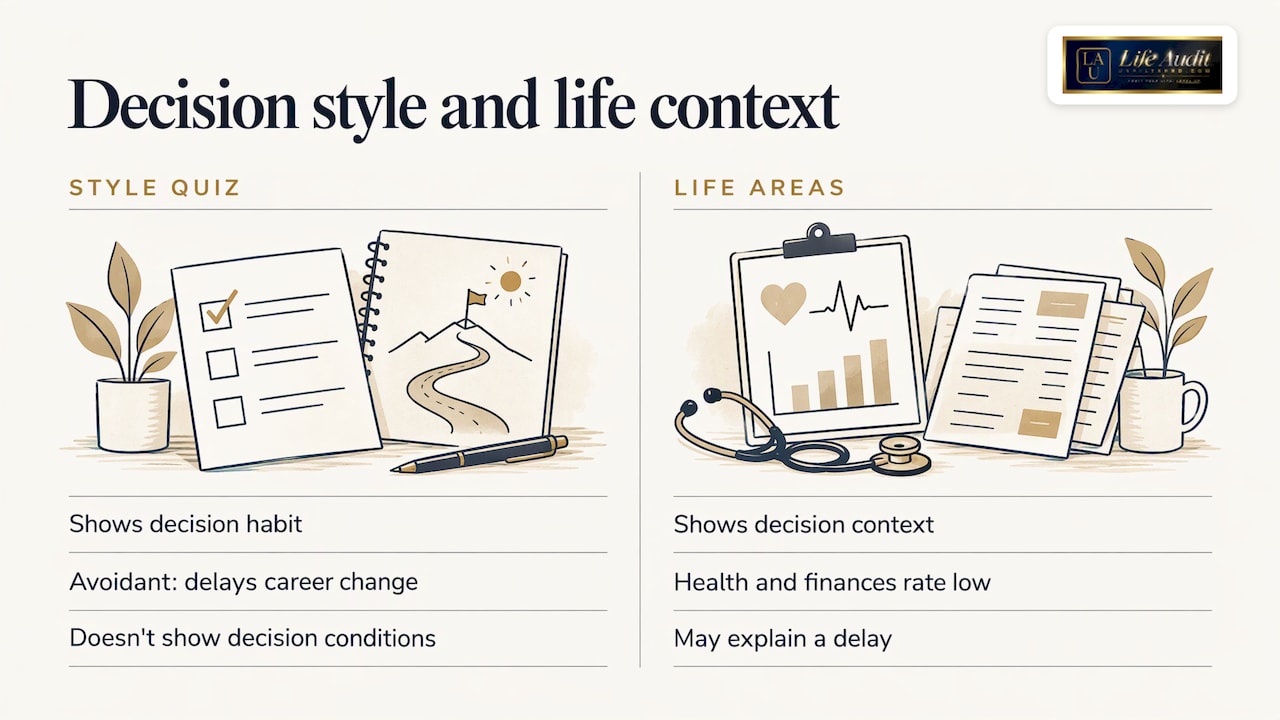
Here is a worked example. Say you score as an avoidant decision maker. You keep putting off a career change. A style quiz says: you delay. That is true, but it is not enough. Now rate ten life areas. You see that your health and your finances are both low. The delay may not be a habit. It may be a sensible reaction to a thin cushion. The fix is different. Instead of forcing yourself to decide faster, you might first steady one of those areas.
This is the gap a style quiz leaves. It tells you how you decide. It does not show what you are deciding under. You need both.
If you want to go wider, our guides can help. How to understand yourself walks through the basics. Personal values assessment helps when you cannot tell what matters most. Values are often the missing input in a hard choice.
For a broader look at assessments that build self-knowledge, this guide to personal growth assessment tools covers several types and what each one is for.
A simple routine to put your results to work
A result sitting in a tab does nothing. Use this routine instead. It takes about an hour spread over a week.
Step 1: Name one real decision
Pick a choice you are facing now. Make it specific. "Should I take the new role by the end of the month?" is better than "What should I do with my life?"
Step 2: Take a style quiz and note your top two
Use a recognized questionnaire. Write down your two highest styles. Do not argue with the result yet.
Step 3: Rate your life areas
Rate each of ten areas, such as health, work, money, relationships and rest. Notice which are low. Those are the areas this decision touches most. You can do this step with our Snapshot.
Step 4: Ask the hard questions
Use the question list above. Spend ten minutes. Write, do not just think.
Step 5: Pick a style to borrow
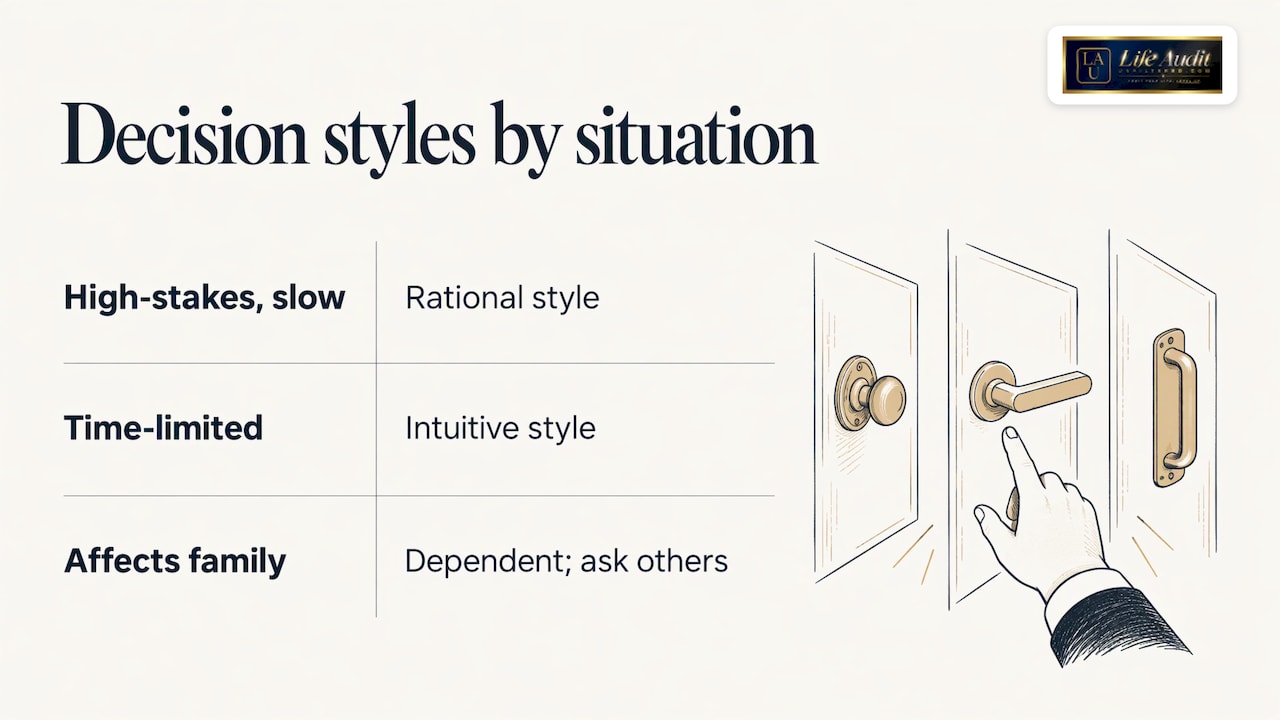
Look at your decision. Ask which style it needs. A high-stakes, slow choice may need rational. A time-limited choice may need intuitive. A choice that affects family may need dependent, meaning you ask. If your habit does not match, borrow the style that fits.
Step 6: Set a decision date and a review date
Write both down. Avoidant types need the first date. Spontaneous types need the second.
Common mistakes
- Taking the label too seriously. A style describes a habit. It does not decide your future.
- Rating yourself on your best day. Answer for a normal week.
- Doing the quiz and stopping. The value is in the follow-up.
- Ignoring the areas around the decision. A low life area can explain a stuck choice better than a style can.
- Making it a verdict. If you use this to judge yourself, you will stop being honest. Use it to get curious.
Our view
We see the same thing again and again in the idea of self-assessment. People want a score. What helps is a pattern.
A decision style tells you how you reach for answers. That is useful. But a choice is never only about style. It sits inside your life. When you rate ten areas, from work to rest, you see what the choice is resting on.
That is why we built Life Audit Unfiltered the way we did. You rate your experience in ten areas. You answer written questions. You get feedback that points to patterns. You do not need an account. You do not need to pay for the first look.
We think anonymous matters here. Honest answers come easier when nobody is watching. And honest answers are the only ones that help.
Start with the Snapshot. If you want more depth, the Deep Dive is there.
Greg
Start with the free Snapshot
If you want to see the life areas behind your decisions, start with our Snapshot. It is free. You rate ten life areas and get an overview based on your ratings. You do not need an account.

Want more? The Deep Dive is a one-time $19 report. It builds on your ratings and written answers, with no subscription. You can look at an example report first.
Related reading
Some readers come to decisions through a different door. If that is you, these may help:
- Online self-assessment: how to choose one and use it well
- Personal growth assessment: how to measure your growth
- Wellbeing assessment: how to choose one and use it well
FAQ
What is the best decision-making self-assessment?
There is no single best one. A good one has clear questions, shows your pattern across more than one style and helps you act. Pair a style questionnaire with a look at your life areas, so you see both how you decide and what the decision rests on.
How long does a decision-making assessment take?
The 20-item General Decision-Making Style questionnaire is short, so it takes only a few minutes. The reflection afterward is where the time goes. Plan to spend about ten minutes writing answers to each question you pick.
Can a quiz tell me what to decide?
No. It shows your habits, not the right answer. A quiz can help you see if you are rushing, stalling or leaning on others. You still make the choice. The questions in this guide help you do that with a clearer view.
Do I need to create an account to use Life Audit Unfiltered?
No. The Snapshot is free and anonymous. You rate ten life areas and get an overview. You can add the Deep Dive later for $19, paid once.
Sources
- What's your decision-making style? (British Psychological Society)
- Problem Solver by Cheryl Strauss Einhorn (Cornell University Press)
- The Decision Making Individual Differences Inventory (Judgment and Decision Making, 2023)
- Improving dynamic decision making through training and self-reflection (Judgment and Decision Making)
- Systematic metacognitive reflection helps people discover far-sighted decision strategies (Judgment and Decision Making, 2023)
- Metacognitive training aids decision making (Batha and Carroll, 2007)