
A life satisfaction test asks you to judge your life as a whole and gives you a number. The best-known one has five questions and takes about a minute. The number is a start. It does not tell you which parts of your life drive it. That is why we built the Life Audit: you rate ten life areas, answer written questions, and see the pattern behind your score. The Snapshot is free and needs no account.
This guide explains what these tests measure, how scoring works, and how to read your result without over-reading it.
TL;DR
- A life satisfaction test measures your overall judgment of your life, not your mood today.
- The most used version, the Satisfaction With Life Scale (SWLS), has 5 statements and scores from 5 to 35.
- A score of 20 to 24 is average in economically developed countries. Lower or higher scores are a prompt for reflection, not a verdict.
- One total cannot show which life areas pull it up or down. Rating areas one by one can.
- Our free Snapshot covers ten life areas without an account. The Deep Dive is a one-time $19.
Table of Contents
- What a life satisfaction test measures
- The Satisfaction With Life Scale, question by question
- Look at the pattern, not only the total
- What a single score can and cannot tell you
- From one number to ten life areas
- How to take any life satisfaction test well
- Taking a test anonymously
- Our view
- Start with your free Snapshot
- FAQ
- Sources
What a life satisfaction test measures
Life satisfaction is the broad, reflective view you take of your life as a whole. The University of Illinois guidelines on measuring subjective well-being describe it that way. They also point out that "happiness" is a loose word. It can mean a good mood, an overall life evaluation, or living a good life.
Three terms get mixed up:
- Life satisfaction. Your own overall judgment of your life, using your own standards.
- Happiness. Often used for emotion. A well-being guide on psytests.org separates the two: life satisfaction is an overall evaluation, while happiness concerns emotional experience.
- Quality of life. Usually about how desirable your circumstances are, with more weight on outside factors such as environment and income, according to the same Illinois guidelines.
So a life satisfaction test is not a mood check. You can have a rough week and still rate your life as a whole as good. You can also have a pleasant week and feel your life is off track. The test asks about the second thing.
If you want the wider picture, our guides on subjective well-being and quality of life assessment cover the neighboring ideas.
The Satisfaction With Life Scale, question by question
The SWLS is the standard. Psychologist Edward Diener and colleagues developed it in 1985, according to the APA Dictionary of Psychology. Diener's own page describes it as a short 5-item scale of global judgments about your life that usually takes about one minute.
The five statements, as listed in the 1993 review by Pavot and Diener, are:
- In most ways my life is close to my ideal.
- The conditions of my life are excellent.
- I am satisfied with my life.
- So far I have gotten the important things I want in life.
- If I could live my life over, I would change almost nothing.
You rate each on a 7-point scale. The APA dictionary gives the range as 1 (strongly disagree) to 7 (strongly agree). The scale is in the public domain, and the SWLS syllabus says no permission is needed to use it. It can be done on paper or by interview, but not by a proxy. Nobody else can answer for you.
How the score is calculated
Add your five answers. The total falls between 5 and 35.
A worked example: you answer 5, 4, 5, 4 and 3. The total is 21. That puts you in the slightly satisfied range.
What your total means
Diener's guide, Understanding Scores on the Satisfaction with Life Scale, gives these bands:
| Total | Reading |
|---|---|
| 30 to 35 | Highly satisfied |
| 25 to 29 | High |
| 20 to 24 | Average |
| 15 to 19 | Slightly below average |
| 10 to 14 | Dissatisfied |
| 5 to 9 | Extremely dissatisfied |
The same guide says 20 to 24 is the typical range in economically developed nations. An earlier review notes that 20 is the neutral point, where you are about equally satisfied and dissatisfied. Other published versions of the bands cut the ranges slightly differently, so treat the edges as soft.
If you land low and stay low over time, the guide suggests talking to a friend, a clergy member, a counselor or another specialist. If your low score comes with persistent sadness, hopelessness, or thoughts of harming yourself, please contact a doctor or a licensed mental health professional. In the US you can also call or text 988, the Suicide & Crisis Lifeline, at any hour.
Look at the pattern, not only the total
The first three items ask about your life now. The last two look back. Diener's chapter on measuring psychological wealth says the gap between them can be telling. High scores on the first three with lower scores on the last two suggest life is going well now but the past leaves you unsatisfied. The reverse suggests you see the past as better than the present.
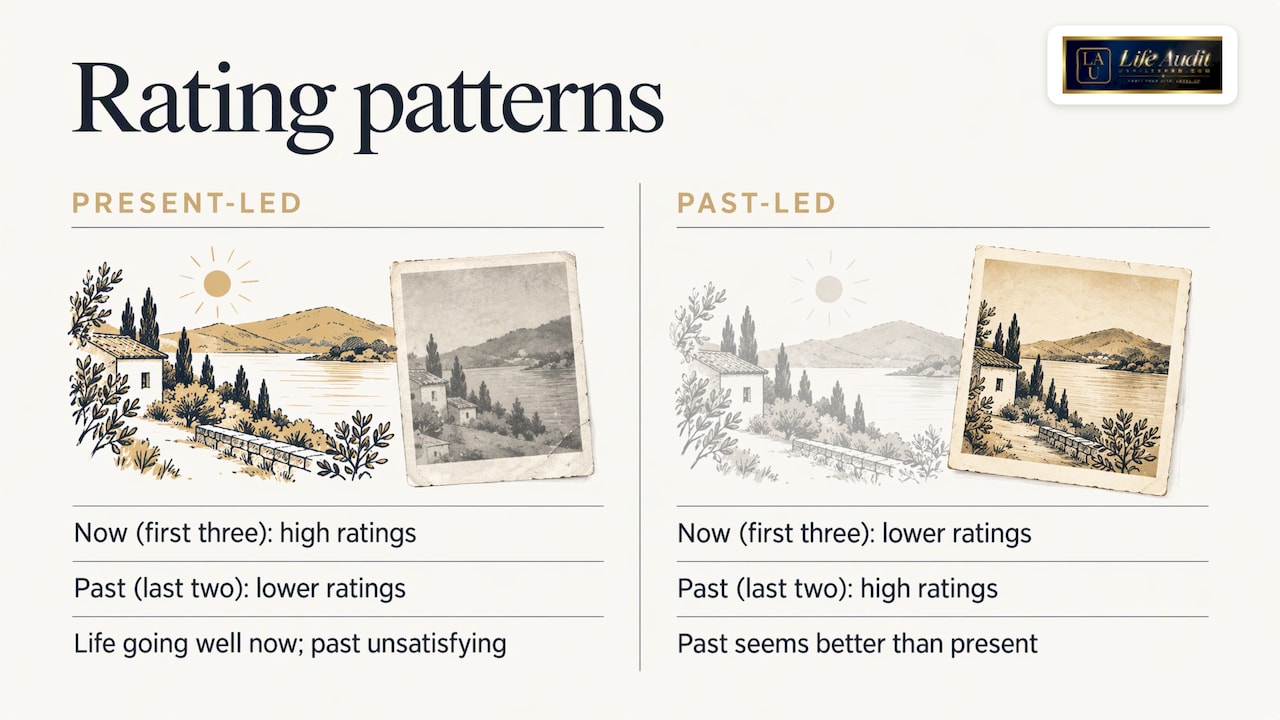
This is a useful habit for any test. Two people can both score 22 for opposite reasons. Ask what moved each answer.
What a single score can and cannot tell you
The SWLS captures your overall judgment, using your own criteria. It does not ask about specific areas such as work, health, or family. Pavot and Diener recommend pairing it with other measures of emotional well-being for that reason. Because each person weighs things differently, the exact meaning of one score is open to interpretation.
That is not a flaw you need to worry about. It is how to use the number well:
- Use it as a starting point. It tells you how you judge your life overall.
- Compare yourself with yourself. Your score today against your score in six months says more than your score against a stranger's.
- Take it at a calm moment. Researchers note that scores can shift with question order, current mood, and how the test is presented. The same paper reports that the SWLS holds up well: reliability in the .80s or higher, and stable results over several weeks.
- Answer honestly, not for show. The answers are for you.
One more caution for students. A test taken in the middle of exam stress will reflect that stress. If that is you, these exam anxiety strategies are worth a read before you take any self-assessment, then take it again when the pressure eases.
From one number to ten life areas
Say your total is 18. You now know you are a little below average. You do not know whether the cause is work, money, health, friendships, or something you have not named. A 5-question scale cannot say, because it does not ask about those areas.
This is the gap the Life Audit fills. You rate your satisfaction across ten life areas and answer written questions. You get personalized, evidence-based feedback on the patterns in your ratings. The patterns are where the useful questions are. A middling total often hides one area you rate very low and several you rate fine. Seeing that changes what you do next.
There are two steps, and you decide how far to go:
- Snapshot. A free overview based on your ratings. It costs $0.
- Deep Dive. An optional, more comprehensive report for a one-time $19. There is no subscription.
Both options are anonymous and privacy-focused. You do not need to create an account to get your first insights.
How to take any life satisfaction test well
A short routine helps whichever test you use.
- Pick a quiet time. Not right after an argument or a great day.
- Answer fast, then check. Your first answer is usually the honest one. Read it back once.
- Write down the total and the date. You need both to compare later.
- Note which answers surprised you. The surprises are the useful part.
- Pick one area to look at. Do not try to fix everything. Choose the area that matters most to you.
- Repeat in a few months. Keep the same conditions so the results are comparable.
If you want to go deeper on related questions, our guides on choosing a wellbeing assessment, online self-assessments, and what to do if you are unhappy with life are a good next step. If one area stands out, the guides on purpose in life, relationship satisfaction, and self-esteem cover each one.
Taking a test anonymously
Many people want to answer honestly without leaving a trail. That is reasonable. Self-reflection works better when you are not worried about who sees it.
The SWLS itself needs no identity. It is five statements and a sum. It is meant to be answered by you, not by someone on your behalf.
The Life Audit is built with the same idea. You can use it anonymously, and you do not need an account to get your initial insights. You rate, you write, and you read your own results.
Our view
We built Life Audit Unfiltered for people who want clarity, not a label.
A single life satisfaction score is a good first question. We think the better second question is where it comes from. Ten areas give you that. You rate each one, you write a little, and the pattern shows up.
We kept the first step free and anonymous. You should be able to look at your own life without making an account or paying. If you want a fuller report, the Deep Dive is there for $19, once.
Our feedback is designed to be evidence-based and personal. It is meant to help you see your strengths and your gaps, and to decide what to do first.
Greg
Start with your free Snapshot
If you have a few minutes, rate your ten life areas and see what pattern comes back. The Snapshot is free and needs no account. If you want more detail afterward, the Deep Dive is a one-time $19 report.

Try the free Snapshot. You can also see an example report first.
FAQ
Is a life satisfaction test the same as a happiness test?
No. A life satisfaction test asks for your overall judgment of your life. A happiness test often focuses on emotions and mood. You can feel low today and still judge your life as a whole to be good.
How long does a life satisfaction test take?
The SWLS takes about one minute, according to its creator's page. A tool that rates ten life areas and asks written questions takes longer, because it asks for more detail. The extra time is what lets you see where your satisfaction comes from.
What is a good score on the Satisfaction With Life Scale?
Scores of 20 to 24 are average, and Diener's guide says that is typical in economically developed countries. Scores of 25 to 29 are high and 30 to 35 are highly satisfied. Your own change over time matters more than where you fall against others.
Can I take a life satisfaction test without giving my name?
Yes. The SWLS needs no personal details. The Life Audit Snapshot is anonymous too, with no account needed for your first insights.
What should I do if my score is low?
Look at which statements you rated lowest, and which life areas those touch. Then pick one to work on. If low scores last, or you feel persistently down, talk with a friend or a licensed counselor or doctor.
Sources
- Guidelines for National Indicators of Subjective Well-Being
- Well-Being & Life Satisfaction Assessment
- Satisfaction With Life Scale (SWLS), APA Dictionary of Psychology
- SWLS, Ed Diener
- Review of the Satisfaction With Life Scale
- SWLS Syllabus
- Understanding Scores on the Satisfaction with Life Scale
- Measuring Psychological Wealth (Diener chapter)
- Psychometric Assessment of Global Scales of Life Satisfaction
- Evidence Backed Exam Anxiety Strategies